The Philippians Paradox
There is a verse in Philippians that has confused people for centuries.
I can say this because it has confused me as well when I have studied it consciously. My first encounter with this verse was when I used the mantra “Who am I?” as a meditation technique for enlightenment.
But I quickly grew tired of it and searched for something different. That was when I found the second part of this verse, which made me think deeply when I meditated upon it.
I had the understanding and inspiration to write this piece after exploring the topics of the law of the mind and mind renewal. Pondering this verse has confused me a great deal because of its apparent contradiction, but it has also enabled me to share my insight on it in the context of mind renewal and personal growth.
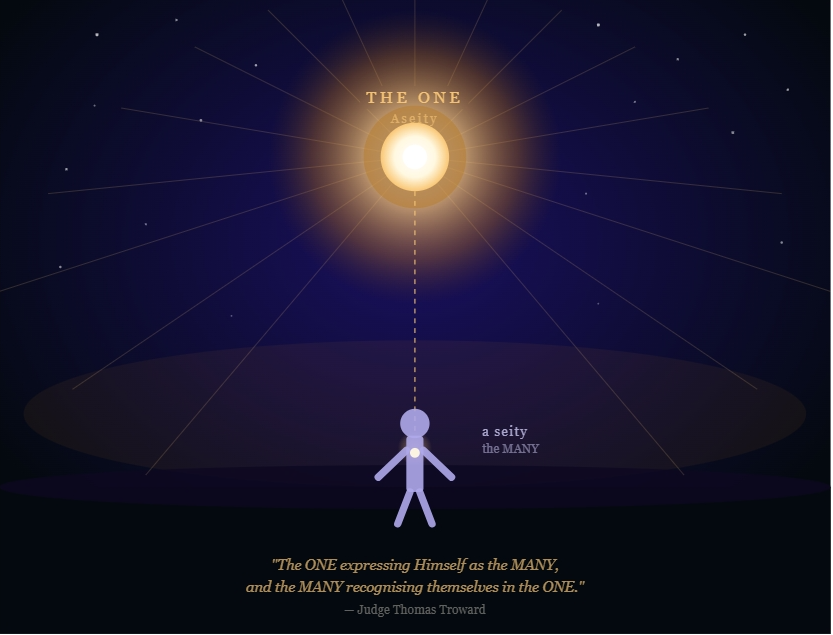
This work is in two parts. Part one, which expatiates the Philippians Paradox you are reading now. Part two explores this further by analysing two words, aseity and seity, which form the psychological root of mind renewal. Let’s explore part one now.
Paul writes:
"Work out your own salvation with fear and trembling, for it is God who works in you both to will and to work for His good pleasure." (Philippians 2:12-13)
On the surface, it sounds contradictory. If God is the One working in you, why do you need to work at all? And if you must work, what exactly is God doing?
Most teaching resolves this tension by splitting the two—assigning some things to God and others to man. But that resolution misses the verse's deeper architecture entirely. The word "for" in verse 13 is the key.
Paul doesn't say "even though God works in you" or "but God works in you." He says, because — work it out, for it is God who works. The divine working is not the reason you are excused from acting. It is the very reason you can act meaningfully.
To understand why, we need to start with the nature of God Himself.
The God Who Originates From Himself
Across spiritual traditions, thinkers and mystics have arrived at a singular conclusion about the nature of God — that He is what some have called the Self-Originating One. This is not a casual description. It points to something precise and profound.
The formal theological term is aseity — from the Latin a se, meaning "from oneself." It refers to the property by which God exists entirely of and from Himself. God does not depend on any cause other than Himself for His existence. He has no origin outside Himself. He is the uncaused cause — the only Being who exists necessarily and eternally, drawing life from no external source.
This concept has two dimensions. In its negative sense, it affirms that God is uncaused — He did not come into being, was not brought into existence, depends on nothing and no one. In its positive sense, it affirms that God is completely self-sufficient — He has within Himself the sufficient reason for His own existence.
This is what God was declaring to Moses at the burning bush. When Moses asked for His name, God did not give a title. He gave a nature: "I AM WHO I AM." (Exodus 3:14)
The root of this name means self-existing — one who never came into being, and one who always will be. He is not defined by anything outside Himself. He is not becoming, growing, or evolving. He simply is. Always.
Jesus echoed this in John 5:26: "The Father has life in Himself." Unlike us — who borrow our breath, depend on food and water, and were brought into existence by others — God's life is uncaused and unborrowed. He does not have life. He is Life.
The Life Placed Within You
Now here is where everything changes. This God — the Self-Originating, Self-Sustaining, Self-Sufficient One — has placed something of that originating Life in you.
Paul declares it in Acts 17:28:
"In Him we live and move and have our being."
God is not just the One who made you. He is the One in whom your very existence is grounded, moment to moment.
This means the locus of divine Life and the locus of your consciousness occupy the same location — your inner world. Your mind. Your will.
This is the resolution to the Philippians paradox. God is not working on you from the outside, doing something to you while you watch. He is working as you — from the inside — but only when you show up to do the work.
The divine working and the human working are not two separate acts happening in sequence. They are one act — experienced from two different vantage points.
When you renew your mind, you are not doing something alongside God. You are the site where God's working becomes conscious and directed.
What the Mind Does When Left Alone
This is why mind renewal cannot be delegated. The mind, left to itself, does something very predictable. It follows the path of least resistance. It defaults to established patterns. It operates by memory and association — interpreting every new situation through the framework of old experiences. It gathers momentum.
And over time, that momentum becomes identity — the same internal world generating the same external circumstances, over and over, with only the surface details changing. Unless this pattern is interrupted, it continues, and we call it fate.
This is not a spiritual deficiency. It is simply how the mind works. Patterns become automatic. Associations become assumptions. Assumptions become the invisible architecture through which we see everything. The Apostle Paul understood this with remarkable precision.
In Romans 12:2, he writes:
"Do not conform to the pattern of this world, but be transformed by the renewing of your mind."
The Greek word for transformed here is metamorphoo — the same word used to describe Jesus's transfiguration. It is not a surface change. It is a change at the level of form, of essence, of inner structure.
And it is caused by the renewing of the mind. Not the other way around. You do not transform and then renew. You renew — and transformation follows. Paul establishes a cause-and-effect relationship that most people live backwards.
Ephesians 4:22-24 makes the structural parallel explicit:
"Put off your old self… be made new in the attitude of your minds… and put on the new self, created to be like God."
Notice that Paul uses a striking phrase — "be renewed in the spirit of your minds." The mind has a spirit. It doesn't just have a view; it has a viewpoint, a posture, a bent. The spirit of the mind is its attitude—the mind takes on an identity over time. Renewal isn't merely intellectual — it goes all the way down.
The Scriptures on Mind Renewal — A Reference Cluster
Several scriptures form the biblical backbone of this truth:
Romans 12:2 — Transformation flows from renewal; the direction of causality matters.
Philippians 2:12-13 — The divine-human partnership in working out what God has placed within.
Ephesians 4:22-24 — The three-movement sequence: put off, be renewed, put on.
2 Corinthians 10:5 — "We take captive every thought to make it obedient to Christ." The warfare dimension — the active discipline of evicting thoughts that misalign with truth.
Philippians 4:8 — "Whatever is true, noble, right, pure, lovely, admirable — think about such things." Not passive positivity, but intentional cognitive alignment.
Colossians 3:2, 10 — The renewed mind flows from a renewed identity. Knowing who you are shapes how you think.
Romans 8:5-6 — Two kinds of minds: one set on flesh, one governed by Spirit. The object of your mental focus determines the quality of your inner life.
Isaiah 26:3 — "You will keep in perfect peace those whose minds are steadfast, because they trust in You." A steadfast, anchored mind is directly linked to the experience of God's shalom.
John 5:26 — God has life in Himself. This is the foundation of everything.
Why This Is Your Responsibility Alone
No one can renew your mind for you.
Not a pastor. Not a coach. Not a mentor. Not even God, acting upon you from outside. The renewal must happen from within the mind itself, which is precisely where God has placed His Life.
The interruption of the cycle — breaking the momentum of memory, association, and accumulated pattern — is an act of will that only you can initiate. God does not override the will. He energises it. But the will must be exercised first.
This is the fear and trembling Paul speaks of — not anxiety, but the weight of knowing that you are the steward of the one thing that determines the shape of your entire inner world. To leave the mind unattended is not neutrality. It is a choice — a choice to let momentum decide your future.
Mind renewal is the interruption. It is the moment you refuse to let the default run. It is the conscious, willful act of re-aligning your inner world with what God says is true — about Him, about life, and about who you are.
And because God's originating Life lives within you, that act of renewal is never yours alone. But it is always up to you to initiate.
The Deepest Reframe
Here is the insight that holds all of this together:
The most spiritual thing you can do is take full responsibility for your mind — precisely because that is where God has chosen to work.
To say "God will do it" while leaving the mind unattended is not faith. It is abdication dressed in spiritual language.
True faith looks like Romans 12:2 — active, willful, daily renewal. It looks like 2 Corinthians 10:5 — taking thoughts captive, one at a time. It looks like Philippians 4:8 — choosing, deliberately, what to set the mind upon.
The pattern of this world is not primarily outside you. It is the accumulated momentum of an unrenewed mind. Transformation begins the moment you interrupt that momentum — and keep interrupting it, until the new pattern becomes the one that runs by default.
That is mind renewal. That is your work. And it is, simultaneously, God working in you.
Thank you, dear reader, for choosing this.
Which of the insights has helped you understand mind renewal? Comment, like and share to help someone understand too.
In part two of this article, we will explore these two words, aseity and seity, as the psychological root of mind renewal.
To begin with mind renewal, read this article Thought, Belief, and Feeling
This article The Secret of Mind Renewal on my Substack also goes deeper into the mind renewal process.