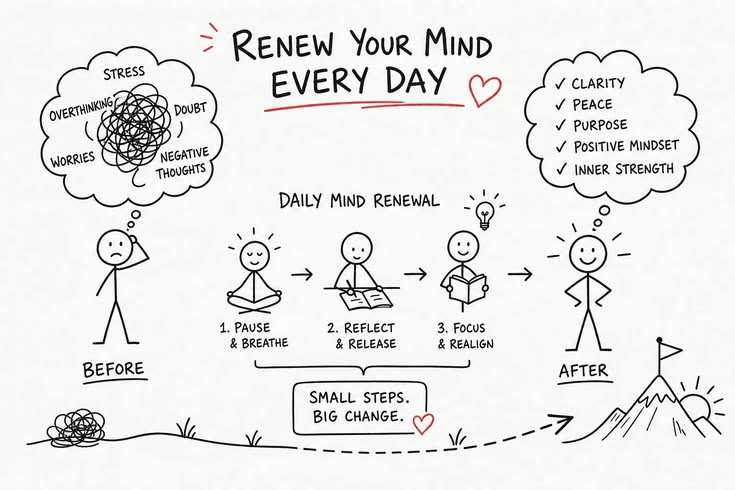
Many Christians know Romans 12:2, but few have built a daily mind renewal practice that turns Scripture into everyday thinking and living.
That gap, between knowing the verse and living differently, is where most people stall. They attend the service, feel the shift, underline the passage, and return to the same mental patterns by Wednesday. Not because they lack faith, but because no one has given them a workable daily structure to continue the process at home.
Mind renewal is not a productivity habit. It is an identity project — the slow, deliberate work of becoming someone whose inner life reflects what they say they believe.
In Ghana, Sunday services and conference experiences carry genuine spiritual weight. But that momentum fades when there is nothing to sustain the work on a quiet Tuesday morning. What carries you through Tuesday is a daily mind renewal practice, not a past peak. By the end of this article, you will have a clear daily routine, a truth-journaling template you can start today, and an honest look at why renewal routines fail and how to keep yours alive.
What "renewing your mind" actually means in Scripture
The phrase most people associate with mind renewal is Romans 12:2. But Ephesians 4:23 goes deeper. Paul writes of being "renewed in the spirit of your mind," and that phrase points to something more specific than thought.
It refers to the inner disposition and motivating attitude behind thought: the part of you that decides what to fear, what to value, and what to believe about who you are. Much devotional content works at the surface layer. This verse reaches further.
The Greek behind the instruction is worth understanding. In Ephesians 4:23, the renewal command is a present passive: go on being renewed. Not a once-off event. Not a breakthrough at a prayer retreat that carries you for six months. A continuous, daily process in which you cooperate with what God is already doing. The present tense implies an ongoing work, not a completed action, a grammatical detail that changes everything about how you build and sustain a daily mind renewal practice.
Think of it this way: waking up and deciding you are confident does not make you confident. But returning to that truth every morning — examining the thoughts that contradict it, replacing them deliberately — builds something over time. That is what the grammar of the passage is pointing toward.
For a helpful philosophical background on why this matters, see The ONE and the Many: The Philosophical Root of Mind Renewal.
Why most devotional routines fail to produce real change
Reading a Bible passage in the morning is a good habit. It is not the same as renewing your mind. Information enters; old thought patterns remain. What most morning routines miss is the deliberate step of confronting the specific thoughts that are actually shaping your behaviour, replacing them with truth, and practising that replacement repeatedly. Without that step, devotions become a comfortable habit with little inner transformation.
The "conference high" is something many Ghanaian believers know personally. A powerful service produces a genuine shift. Then, within days, the same anxious patterns return, the same self-doubt, the same fear about money or the future. This is not a lack of zeal. It is the absence of a structured daily habit to continue the work after the emotional peak fades. Renewal built on emotional peaks cannot hold. What holds is a quiet, consistent daily mind renewal practice that does not depend on how you feel when you wake up.
Your Daily Mind Renewal Routine: Morning, Midday, and Evening
Morning: setting the inner direction before the day does
Begin with one minute of stillness. No phone, no news, no conversation. Then offer a short, grounded prayer:
"God, guide my thoughts today."
Read one short Scripture passage slowly and identify a single phrase that speaks to where you are right now. Write one truth statement from that phrase and one clear intention for the day.
The entire morning sequence takes five to ten minutes. That is the goal: brief, consistent, and anchored to truth before anything else competes for your attention.
Midday: the sixty-second recentring
By midday, the dominant thought pattern of the day has usually revealed itself. Anxiety about a conversation. An old lie about inadequacy. Distraction pulling focus from what actually matters. Pause for sixty seconds and repeat your morning Scripture phrase silently. If a specific thought has been recurring, write it down in one sentence. Naming a thought diminishes some of its power and prepares you for the deeper work in the evening.
Evening: the thought audit that builds real renewal
The evening session is where the deepest work happens. Honestly, spend five minutes reviewing the day. Write the thought pattern that dominated most of the day, then write the truth that counters it using Scripture or a grounded faith statement. End with three things you are grateful for and a short prayer that releases the day. That written audit, done honestly and briefly, transforms the routine from a morning ritual into a genuine identity-shaping discipline.
Scripture meditation and truth journalling done right
Scripture meditation is not passive reading. Choose a short passage of three to ten verses. Read it once for general meaning, then read it again and identify one phrase that stands out. Ask what it reveals about God, about identity, or about the thought pattern you are working through. Turn that phrase into a short prayer and carry it as a mental anchor for the day. The goal is depth with one passage, not breadth across many chapters.
Truth journalling, a practical daily devotional for mind renewal, is the practice of writing your thoughts down, examining them honestly, and replacing distorted ones with Scripture-grounded truth. The template is simple:
write the dominant thought in one sentence, assess whether it is accurate or distorted, write a truth statement that responds to it, and name one action step that aligns with that truth.
The act of writing externalises what is otherwise circular internal noise — and it gives truth somewhere to land.
- "What am I believing about myself right now?"
- "What does Scripture say is true about this?"
- "What would I do differently if I believed that truth today?"
Working through these questions does not require lengthy writing; a few sentences per prompt is enough. Practised daily, they help apply what Romans 12:2 describes: a renewing of the mind that is consistent with Scripture's call to ongoing transformation.
Replacing thoughts intentionally, not suppressing them
Second Corinthians 10:5 is not a call to white-knuckle your way through difficult thoughts. Taking a thought captive means noticing it, naming it clearly, and then deliberately choosing a different thought in its place. Suppression tries to push the thought down. Replacement gives it a truthful answer and redirects attention.
The practical step is to write the intruding thought, identify the specific lie or distortion it carries, then write the biblical counter-statement.
This is precisely why structure matters more than willpower. The Lifeward Coaching LIAM Framework (see Living Lifeward: The Daily Practice of Spiritual Truth) is built around this reality. The "Method" layer of that framework gives you a daily disciplined practice that anchors renewal in identity rather than mood. The question shifts from "Do I feel like doing this today?" to "Who am I becoming through this practice?" That identity-level reframing is what separates a discipline that sticks from one that fades after two weeks. It is not about effort alone; it is about a system that works even on low-energy days.
How to maintain a daily mind renewal practice past the first week
The obstacles that derail most renewal routines fall into a predictable cluster: perfectionism after a missed day, vague scheduling that never becomes automatic, and the habit of measuring progress by feeling rather than by faithfulness. Renewal rarely feels dramatic on a Tuesday morning. The evidence comes later, in how you respond under pressure, or how quickly you return to truth after a setback.
Starting small is not a compromise; it is a strategy. Begin with five minutes. Keep the journal physical if possible, since writing engages the mind differently from typing. If a day is missed, restart the next morning without guilt. Habit-formation timelines vary from person to person, but a 30-day commitment gives the morning sequence and evening thought audit the best chance of becoming a natural rhythm rather than a discipline you have to remember. The goal is not to feel renewed every morning.
The goal is to build a daily mind renewal practice that is woven into how you live, think, and see yourself.
Start before you feel ready
A daily mind renewal practice is not complicated, but it does require intentionality. The scriptural foundation is clear: renewal is ongoing, it works at the deepest level of the mind, and it shapes identity from the inside out (see Ephesians 4:23). The routine in this article provides a practical structure to start today.
Begin with one step if the full routine feels like too much. Sit with one verse tomorrow morning. Write one truth statement. Notice what shifts over the following days.
If you want a structured guide that takes you through this process within a framework designed specifically for the Ghanaian context, Lifeward Coaching's online course and the LIAM Framework exist precisely for this journey — see Start Early: Why Mind Renewal Is Your Sole Responsibility. You do not have to build the system from scratch alone.
Sustained daily practice tends to produce more lasting change than isolated conference experiences, because every day you return to truth, you become someone who lives by it.
Thank you, dear reader, for choosing to read this article. If you have found this article valuable, like, comment and share with your friends and family to contribute to their spiritual growth.
Below are similar articles that further your understanding of how mind renewal works. Enjoy the read.